|
|
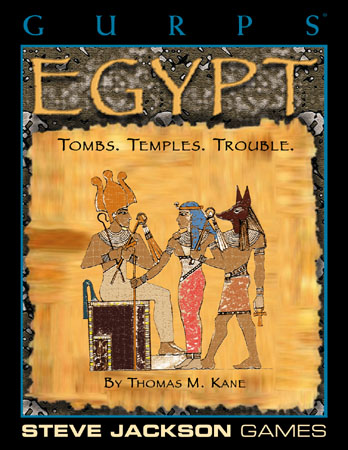
Excerpts from GURPS EgyptTomb Defenses (from the sidebar on pp. 95-96)In early dynastic Egypt, people made their tombs accessible so that priests of the mortuary cult would have full access to their bodies – living warriors kept robbers away from the graves. As centuries passed, it became impossible for the cult to defend all the tombs of Egypt. Therefore, corpses began to be buried in places separate from the mortuary temples, and various mechanical and psychological measures were taken to protect the dead. Most tomb defenses were rather simple. False tombs, sometimes equipped with small amounts of treasure so as to fool robbers, were built in accessible locations, while the actual tombs were in secret, wilderness places, their entrances blocked with enormous slabs of stone. The mortuary cult also propagated the idea that the ka of a dead person protected the grave, either as a ghost or by animating a mummy. Some wealthy people had the bodies of animals or commoners mummified and placed in their tombs to become undead guardians. Egyptians didn't perform human sacrifice to create tomb-guardians, although in a fantasy campaign some particularly ruthless magician might do exactly that. Egyptian tombs also contained a variety of traps: pits, mechanisms that fired poisoned darts, blocks of stone positioned to fall either on or behind intruders, killing them or sealing them in, and so on. Tombs seldom contained enough space for elaborate mazes, but some contained twisting corridors that led to dead ends and decoy graves. Any of the traps which appear in fantasy dungeons might show up in an Egyptian tomb, although probably not in the usual profusion. If magic exists, magical tomb defenses are common. Medieval Arabs believed that Egyptian sorcerers had turned the most valuable grave goods invisible, and that only those capable of speaking the appropriate passwords could ever find them. Because of their antiquity and the status of their owners, magic amulets stolen from royal bodies or magic spells copied from royal tombs were assumed by usurpers to be more powerful than those commonly available – the spells designed to protect the dead could actually attract robbers centuries later. Of course, none of these defenses could protect the tombs from those who worked in the royal cemeteries – the priests of the mortuary temples and the workmen who dug and decorated the tombs. In Nubia is an example of a tomb robbed by way of an underground tunnel dug by a construction crew as they were building a tomb adjacent to it! Similar incidents occurred in Egypt proper, but only when workmen accidentally intruded on an old tomb while digging a new one. The worst thefts in the Valley of the Kings were officially sanctioned under the guise of restoration and protection during the XXth and XXIst Dynasty reigns of High Priests Herihor, Piankh and Pinedjem, when dozens of royal mummies were removed from their tombs, unwrapped and "mined" for gold, and then rewrapped and hidden in a number of mass caches. The high priests also reused some of the "excess" grave goods in their own funerals – Pinedjem was buried in two recycled coffins of Thutmose I! Djadjaemankh's Magic (from the sidebar on p. 43)Once, so the story goes, when Pharaoh Snefru grew melancholy, he summoned the wizard Djadjaemankh to suggest some form of amusement. The sorcerer organized a boating expedition with 20 beautiful women, naked but for fish nets, serving as Pharaoh's rowers, each equipped with a paddle carved from ebony and inlaid with gold. Snefru enjoyed the trip, admiring the scenery both outside and inside the boat. During the trip, Snefru's chief wife, Mertitefs, lost her turquoise bracelet over the side of the vessel. She began to howl and curse, setting up such a din that Snefru couldn't ignore her. Although he promised to have his artisans make a duplicate of the bracelet, Mertitefs insisted that it could not be replaced. Pharaoh Snefru ordered Djadjaemankh to recover the lost ornament. The wizard magically made the water on half of Lake Faiyum rise up into the air, and he stacked this mass of water on top of the water in the other half of the lake. Then he walked across the dry lakebed, recovering the bracelet before allowing the water to flow back into the lakebed. Rotting Touch Advantage – 28 points (from p. 80)This advantage allows an undead creature to inflict a flesh-destroying disease on the living by touch. The victim may avoid the effects by making an HT roll, but if this fails, the rot inflicts a point of damage, the affected flesh turning gray, becoming mushy, and rubbing away. Every 24 hours until dead, the victim loses another point of HT (if he fails an HT roll), unless he has a critical success on one of his HT rolls (which halts the progression of the rot) or someone cures the condition magically or surgically. Up to an hour after the Rotting Touch attack, the victim may excise the rotted flesh, suffering 1d-2 points damage. Someone making a successful First Aid roll can remove the infected tissue without causing additional damage. After the initial hour, only amputation or surgery can medically arrest the decay, and trained surgeons willing to perform such operations are rare in Egypt (see Medicine, p. 7). Hitler and the Hittites (from the sidebar on p. 53)Our understanding of the politics of the Hittite Empire began with a series of German archaeological discoveries made shortly after the First World War. Adolf Hitler, always fascinated by the early history of the Nordic people, may have read about the exploits of the Aryan Hittites, the first Indo-Europeans to enter the Mediterranean historical record. Some think that when the future dictator decided to stop calling himself Schickelgruber he chose the name "Hit-ler" in a deliberate attempt to invoke the greatness of the "Hit-tite" empire. In an Illuminati campaign, this coincidence may have great significance. The Hittites employed espionage and subversion on an international scale; if a great conspiracy has dominated human history, they could easily have played a part in it. If there was an occult purpose behind Hitler's apparently insane actions, the explanation may lie in the ruins of Hattusas.

|

|