
 January/February 1994
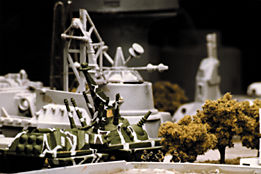
Have your tabletop slugfests between the armored might of the Ogres and the great Japanese hero Godzilla gotten stale and predictable? (Now, there's a sentence you don't see every day . . .) Here are some new optional rules for use with "Godzilla 2072" (published in Pyramid #1), plus two new monsters for use in Ogre Miniatures.
A "noble" Godzilla will do everything possible to avoid "civilian" casualties. He will not enter town terrain (unless chasing a rogue Ogre or another monster), and he will not attack any unit that has no attack value (i.e., command posts, hovertrucks, and most D0 units).
Godzilla can automatically turn a square inch of town or forest into rubble simply by moving through it during the movement phase and announcing that he is destroying it by overrun. Thus, Godzilla can turn up to six inches worth of town or forest into rubble in a single turn.
Let Godzilla team up with a force of armor and infantry (and/or Ogres) against a larger enemy force. Obviously, Godzilla should be "smart" and "noble" for this scenario.
For game balance, the larger force should be built with 175 more armor points than Godzilla's side.
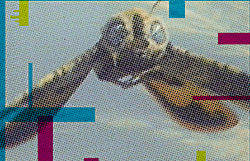
While certainly not the equal of Godzilla in the hearts of movie monster fans everywhere, Mothra is a formidable foe that could give the King of Lizards a run for his money, or completely annihilate an unprepared armor force! The giant moth has had a long and distinguished film career (see p. 36 for his complete record of, um, achievement). Here's everything you need to know to add the Winged Monstrosity to your Ogre Miniatures game:
Mothra has a double move, which works the same way it does for GEVs. Mothra moves 8" in the movement phase and 6" in the GEV 2nd movement phase after combat.
As Mothra is actually flying when moving, terrain features are meaningless to him and are ignored for movement purposes, except that he must "pay" one inch of movement for every level he must ascend to pass over levels. For example, to cross a level 3 ridge, Mothra must subtract 3" from his movement allowance. Mothra may pay part of this cost one turn, waiting in front of the elevation, then pay the remaining cost next turn and move over the elevation. Mothra can do this as many turns as necessary.
Mothra tends to fly at just above ground level, but because of his great size, he is still firing from a high enough elevation to negate any hull-down or out-of-LOS defensive bonuses intended victims may receive (though hard-cover defensive bonuses still apply).
Because of his huge wings, Mothra may not land in a town to gain the double defense strength bonus. Mothra cannot travel underwater, and is equal to a Size 9 Ogre for all other movement and cover purposes.
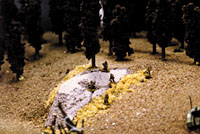
Mothra can "fire" a thick stream of biological monofilaments. He can use them several different ways, as shown below. Mothra must declare the attack type before making a roll on the Combat Results Table. For purposes of range, measure from the top of Mothra's head.
Acid: Mothra fires an acidic paste with an attack strength of 4 and a range of 4". This attack has no spillover effect. Against Godzilla, and other monsters, this attack is against body points (at 1-to-1 odds). Note that since this is not an energy-based attack, Godzilla could not absorb energy from it if he were the target.
Entanglement: Mothra fires a series of web-like monofilaments that affects an area 2" across (use the spillover fire template any unit or monster touching the area is affected). The weapon has a 2" range. The attack entangles other monsters and Ogres, and disables armor units and infantry. The attack automatically succeeds against any unit in range; no roll on the CRT is necessary. Against Godzilla, other monsters and Ogres, this attack will temporarily remove body points (on Godzilla) or tread points (on an Ogre) at a rate of 4 points per attack. Against armor and infantry, this attack will automatically disable the unit (or immobilize the infantry). Monsters and Ogres may get 1d6 points back per turn if they do not move during their turn, working instead to break free of the webbing (though they may still attack normally). Armor and infantry must roll to become undisabled (use the rules for GEVs working free of swamps) every turn until they succeed.
Hallucinogen: Mothra fires a fine spray that has no effect on machinery (such as Ogres), but will affect living creatures (other monsters, infantry, militia and crews of armor units). The hallucinogen spray has a range of 2" and affects an area 2" across (use the same rules as above). This attack is also automatic, but the targets may shake off the hallucinogen's effects. Other monsters are affected on a roll of 5 or 6 on one die, while infantry and armor units are affected only on a roll of 6 (it's hard for the hallucinatory spores to get into the life-support systems of the battlesuits and armor units). Militia are affected on a roll of 3-6 (they're not nearly as well protected).
If the hallucinogen takes effect, the affected monster or unit will not attack Mothra that turn, and will instead move randomly (spin any convenient marker to determine direction) and will attack anything they overrun (except Mothra), friend or foe. If they don't make an overrun attack, they will fire at the nearest unit (friend or foe), other than Mothra, at the end of their movement. GEVs will wander randomly (using the same method as above) during their 2nd movement phase.
Ogres are not affected by the hallucinogen, and all monsters and units recover automatically on the next turn.
Mothra may use his huge wings and biological monofilament to engage in overrun combat. This is represented by an attack strength of 6 in an overrun that he may distribute among as many as six targets during each round of the overrun (i.e., 6 pts. against one target, or 4 pts. against one target and 2 pts. against another, or 1 pt. against six targets, etc.). Mothra may elect to use his entanglement attack during any overrun fire round in lieu of his 6 attack strength points. Any infantry or armor units immobilized in this manner may not fire for the remainder of the overrun combat.
Because he flies, Mothra can disengage from overrun combat at the end of any pair of overrun rounds at his choice (unless fighting another flying monster - even then, both monsters could agree to disengage).
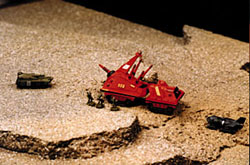
Mothra has 60 body points. His movement slows as he takes damage (see the chart at the end of this article).
All attacks against Mothra are at 1-1 odds, with the attack strength (single or combined) equalling the number of body points lost if the attack succeeds. If an attack, or combination of attacks, equals 20+ attack strength, then the odds become 2-1.
Mothra automatically regenerates 1d6 body points (up to his maximum of 60) during his 2nd movement phase.
If Mothra ever reaches 0 body points, he is dead and may not regenerate.
Mothra may shoot down Cruise Missiles with the same odds as a laser tower. He must use his breath weapon, but its range is increased to 6" (for the purpose of shooting down a Cruise Missile only).
Mothra may shoot once at every missile launched at him in a turn. This does not affect his ability to fire in normal or overrun combat.
Mothra is considered size class 9 for all other purposes.
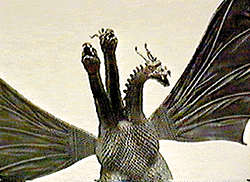
Ghidrah (also known as Monster Zero) is a fearsome bat-winged, three-headed, two-tailed monster under the control of the evil would-be conquerors from Planet X, a hidden planet beyond the orbit of Jupiter. In the classic film Godzilla vs. Monster Zero, Ghidrah was sent by the X-ians to soften up Earth for an invasion. Godzilla and Rodan (both under the influence of a Planet X mind ray) started out fighting alongside Ghidrah, but turned on him in defense of the planet when intrepid Japanese astronauts found a way to counter the effects of the mind ray. Ghidrah had some other cinematic adventures Here's everything you need to know to add King Ghidrah to your Ogre Miniatures campaign:
Ghidrah has two modes of movement, ground and air. He can move 6" on the ground, or 8" in the air, and can only choose one in a given turn.
When moving on the ground, Ghidrah uses the Ogre column on the Terrain Effects Chart, except that he does not get stuck in the swamp permanently. Ghidrah can either struggle out on the ground (roll one die: on a 1-3, Ghidrah may move normally, and on a 4-6, he is stuck for the turn), or he can fly out at any time.
Ghidrah's flying movement is really more of a low glide. While he can clear Level 1 obstacles with ease, Ghidrah cannot fly over taller objects, and must climb up them (though with his wings beating furiously, he has no movement penalty for climbing).
Ghidrah may, like Godzilla, step off a cliff of any height and take 1 die of damage to his body points for every level fallen beyond the first. If he lands atop enemy armor or infantry, he automatically destroys one unit under him (roll randomly). If the unit he falls on is an Ogre, it suffers a 1-1 attack against every weapon and takes 3 dice of tread damage. Surviving enemy units or Ogre weapons are then considered to be defending against Ghidrah in overrun combat and may take the first fire round.
Ghidrah can travel underwater like an Ogre. He can surface and attack at any point in the water. Ghidrah uses his breath weapon while surfaced, but not when underwater. When underwater, he can only be attacked by Ogre missiles, marines, Cruise Missiles, howitzers, mobile howitzers and of course other monsters. Ghidrah may conduct overrun combat normally underwater except for his breath weapon.
Treat Ghidrah as a Size 9 Ogre for all other movement and cover purposes.
Ghidrah has two modes of attack. In normal combat, in the firing phase, Ghidrah sends forth a set of three powerful electrical blasts (one from each head) that overloads even the best-shielded systems and vaporizes protective armor. Ghidrah can direct this attack at three separate targets, or he can combine the attacks against a single victim! In overrun combat, Ghidrah can either use this breath weapon or a rampaging, stomping, two-tail-swinging physical attack. For purposes of range, measure from the top of Ghidrah's middle head.
Ghidrah's breath weapon has an attack strength of 4 per head and a range of 3". Ghidrah may only attack once per head in the firing phase. This breath weapon, like a laser attack, has no spillover effect. Because of his great height, Ghidrah may use his breath weapon at targets over or behind forests or level 1 cliffs, unless the target is hiding directly adjacent to the cliff. Units may still take hard cover bonuses.
There is no energy reserve to deplete; Ghidrah will continue to attack until he dies. However, with each 20 points of body damage Ghidrah takes, one of his three attacks is lost (though with his regeneration ability, he may get the attack back).
In overrun combat, Ghidrah may attack once per fire round, using either his three-part breath weapon or his stomp/tail/thrash attack. This physical attack has a strength of 4, and can be used against any single target. Any unit in contact with Ghidrah is considered to be in overrun combat with him.
The attack strengths of the breath weapon and physical attack are not doubled in an overrun.
Ghidrah may not ram; he may be rammed, but only if he used ground movement in his previous movement phase. Follow the same procedure as for ramming an Ogre. Consider Ghidrah a Size 9 Ogre for purposes of being rammed. Any resulting damage is taken off of Ghidrah's body points.
For all other combat purposes, treat Ghidrah as a Size 9 Ogre.
Ghidrah has 60 body points. His movement slows as he takes damage (see the chart at the end of this article).
All attacks against Ghidrah are at 1-1 odds, with the attack strength (single or combined) equalling the number of body points lost if the attack succeeds. If an attack or combination of attacks equals 20+ attack strength, then the odds become 2-1.
Ogre antipersonnel batteries don't hurt Ghidrah.
Ghidrah automatically regenerates 1d6-1 body points (up to his maximum of 60) at the end of the GEV 2nd Movement phase.
If Ghidrah reaches 0 body points at any time, he is dead and may not regenerate.
Ghidrah may shoot down Cruise Missiles with the same odds as a laser tower. He must use his breath weapon, but its range is increased to 6" (for the purpose of shooting down a Cruise Missile only).
Ghidrah may shoot once at every missile launched at him in a turn. This does not affect his ability to fire in normal or overrun combat.
