




Multi-Player Variants
by Steffan O'Sullivan
Knightmare Chess is such a fun game it's a shame to limit it to just two players. Fortunately, there are many multi-player chess variants - Knightmare Chess can be played with most of them with the same delight.
I've played many variants, but Knightmare Chess inspired me to write my own. My four-player variants owe their basic format to Richard Hutnik's Corner Chess, but have significant differences, and so are different games. My three-player variant was inspired after playing some of the others on expanded boards - I wanted a game in which there was more interaction more quickly.
You'll need to get more pieces to play these variants. Fortunately, inexpensive chess sets are readily available at most large chain stores which carry games at all. Pressman makes a very inexpensive set with brown and tan pieces, while there are many sets with white and black, or white and red pieces. Or you can get some fancy sets and play, for example, the Simpsons against a Samurai army. All of these variants use a standard chess board.
General Rules
There are some general rules when using Knightmare Chess with three or four players.
- Deck-Building: it is probably best to play with the Common-Deck rules if you only have one deck. When the draw pile is empty, finish the game with the cards in your hands - unless the players agree before the game begins that they will reshuffle when the draw pile is empty. If each player (or team) has his own deck, you may build 150-point hands from those.
- Victory: the last player with an uncheckmated king wins. It doesn't matter who checkmated the earlier victims - only the last one to survive is the victor.
- Checkmate: if you find yourself checkmated on your turn, remove your
king but leave the rest of your pieces on the board. Your opponent does
not have to actually capture your king - simply checkmating it is enough
to cause it to be removed from the board. The remaining pieces of a
checkmated king are left standing. They may be captured by moving into
their spaces, but you may not move through them. They may not move and
do not exert a check - an opponent's King may move right by them with
impunity.
- Even if you are in a position to capture an opponent's king at the beginning of your turn (through another opponent having moved a piece out of the way, most likely), you may NOT capture the king. You may try to strengthen the check, or attack another piece of the same player while leaving your checking piece where it is, etc. If you leave the king in check, say "Check" at the end of your turn. If he is then checkmated, his action is to remove his king.
- Timing: "Play this card immediately after your opponent's move" - these cards may be played after any opponent has made his move. You may play one after each opponent has moved, in fact.
- "Your Opponent" - in general, such cards only refer to one opponent or another - White may play Challenge, for example, and require either Black or Red to move a specific piece, but not both. A card such as Vendetta affects all players, however, as does Abduction. (That is, all other players must look away for ten seconds when Abduction is played, and a piece may be abducted from any ONE of your opponents!) This also means, however, that something like Doppelganger can refer to any opponent, not just the most recent one to move.
- Any card, such as Revenge, which specifies doing something to your opponent when he does something to you can only refer to the opponent whose action triggers the use of the card.
- Any card, such as Anathema or Holy Quest, which requires you to swap the position of two of your opponent's pieces, must be two pieces of the same opponent. (In the four-player Team-Play variant, however, you may affect a piece from one opponent and a piece from his team member. For example, Black could switch the position of Red's bishop with White's knight by playing Holy Quest.)
- Neutrality: a piece can only be moved by one opponent between two of the owning player's turns. That is, if Black's rook is Neutral, either White or Red (or Brown) could move it during their turns, but not more than one of them.
- Fireball: the reduced number of pieces per player, but increased crowdedness of the board make it too deadly - it is recommended that you remove Fireball from the deck before play. Awwww . . . All right, you could instead reduce its effectiveness: allow each affected opponent to remove any two pieces it is adjacent to when it explodes. Note that these do not have to be their own pieces.

The Three Player Chess Variant
Pieces:
White has twelve pieces: six Pawns, two Bishops, one each of Knight, Rook, Queen, and King.
Red and Black each have ten pieces: four Pawns, two Bishops, one each of Knight, Rook, Queen, and King.
Board:
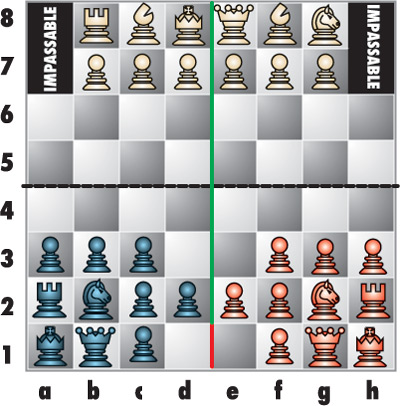
-- Equator
– Midline: line dividing the board between Black and Red starting positions.
– Impassible Barrier: no piece may cross this barrier or check across it. Diagonal movement is allowed through the corner. That is, a Bishop could move from d2 to e1, for example, and Knights are not affected by the barrier at all.
Rules for the Three-Player Variant:
Normal chess rules apply except where noted. White plays first, followed by Red then Black. Play proceeds clockwise around the table.
Only White may Castle - move the King one space, and place the Rook on the King's starting space. Neither may have moved beforehand, and the King must not be in check at the time of castling. (In Knightmare Chess, Black or Red may castle by playing the Sanctuary card.)
Black and Red Pawns move towards White's position, not toward each other.
Any pawn that begins the game in the second rank may move two spaces on its initial move. En passant rules apply. Any pawn that begins the game in the third rank may only move one space at a time (unless a Knightmare Chess card is played that allows otherwise).
Note that in order for the Black a3 pawn and Red h3 pawn to promote, they must somehow be moved over at least one lane.
The Black d2 pawn may not capture the Red e2 pawn until one or both are across the Equator. Likewise, the Red e2 pawn may not capture the Black d2 pawn until one or both are across the Equator. However, such a pawn may capture any other piece across the midline in a normal pawn capture, and then is free to move and capture without restriction. No other Black or Red piece has any restriction regarding the midline or equator. White's pieces have no midline or equator restrictions at all.
Knightmare Chess specific rules:
The corners of the board, for cards such as Squaring the Circle and Figure Dance, are a1, b8, g8, and h1.
Toll and Betrayal: White's territory is everything on his side of the equator. Black and Red have territory defined by the equator and the midline.
The Four-Player Chess Variant: Free-for-All
Pieces:
Each of the four sides (White, Black, Red, Brown) has nine pieces: one King, one Queen, one Rook, one Knight, and five pawns.
Board:
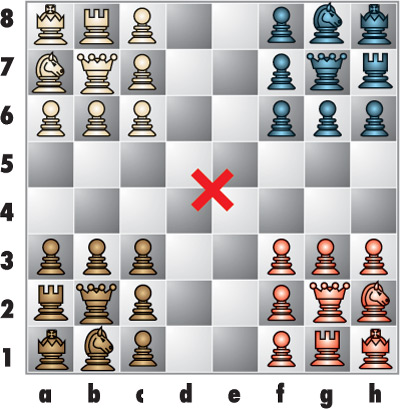
X You may not move or capture diagonally through this vertex. For example, you may not move from d4 to e5 directly. It has no effect on knights or on any orthogonal movement. Use a penny or similar object to show the impassible vertext.
Rules for the Four-Player Free-for-All Variant:
Normal chess rules apply except where noted. White plays first, followed by Black, Red and Brown. Play proceeds clockwise around the table.
Castling is only allowed by play of the Sanctuary card.
Pawns may move one space orthogonally in one of two directions: away from the owning player's corner. That is, a pawn on a3 may move to a4, or it may move to b3 should that space become empty. Capturing is still only diagonally, but a pawn on b3 may capture at a4, c4, or c2. A pawn may move vertically one turn, and horizontally on the next. Note that the pawns are thus very powerful and flexible, being able to change file as well as rank.
No pawn may move more than one space in a given turn except as allowed by a Knightmare Chess card. There is no en passant. When a pawn does move more than one space with use of a card, it must move in a straight line.
Promotion takes place in the furthest rank or the furthest file. That is, Brown's pawns may promote in either rank 8 or file h. You may promote to any piece, even a bishop.
Knightmare Chess specific rules:
Toll and Betrayal: each player's territory is one quarter of the board.
Cards that require a bishop to be usable, such as Holy War or Crusade, may be handled in one of three ways:
- Such cards are simply dead-weight, and must be discarded to get them out of your hand. This is the default condition, if no other method is chosen beforehand.
- Such cards may be removed from the deck beforehand - or simply discarded as drawn, and an immediate replacement card drawn. Note that this would only apply to cards that REQUIRE a bishop to be usable.
- Since pawns in this game are more powerful, allow them to be used on pawns instead of bishops! Note that since there are more pawns in this version than bishops in two-player chess, this makes those cards worth more points if using the point-cost system.
The Four-Player Chess Variant: Team Play
Pieces:
Each of the four sides (White, Black, Red, Brown) has nine pieces: one King, one Queen, one Rook, one Knight, one Bishop, and four pawns.
Board:
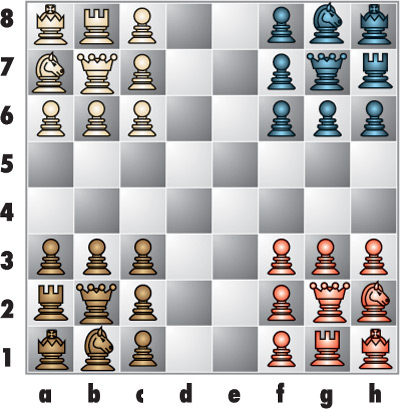
Note that there is no obstruction to the center vertex in the team version.
Rules for the Four-Player Team-Play Variant:
Normal chess rules apply except where noted. White plays first, followed by Black, Red and Brown. Play proceeds clockwise around the table.
The two teams are White-Red versus Black-Brown. You must checkmate both opposing Kings to win. You may not normally capture your team member's pieces - however, a card such as Assassin or Distintegration allows you to capture your team member's piece. If your team member has been checkmated, you may also capture his remaining pieces.
Castling is only allowed by play of the Sanctuary card.
Pawns may move one space orthogonally in one of two directions: away from the owning player's corner. That is, a pawn on a3 may move to a4, or it may move to b3 should that space become empty. Capturing is still only diagonally, but a pawn on b3 may capture at a4, c4, or c2. A pawn may move vertically one turn, and horizontally on the next. Note that the pawns are thus very powerful and flexible, being able to change file as well as rank.
No pawn may move more than one space in a given turn except as allowed by a Knightmare Chess card. There is no en passant. When a pawn does move more than one space with use of a card, it must move in a straight line.
Promotion takes place in the furthest rank or the furthest file. That is, Brown's pawns may promote in either rank 8 or file h.
Knightmare Chess specific rules:
Toll and Betrayal: each player's territory is one quarter of the board.
